
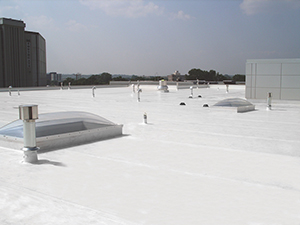
Commercial property owners in Brice Prairie, WI may consider TPO roofing when they need a single-ply membrane system for a flat or low-slope roof. The better question is not whether TPO is “perfect” for the local climate, but whether the building, roof deck, drainage, attachment plan, and maintenance access support the system. Golden Eagle Roofing installs TPO roofing for commercial buildings in Wisconsin. Call (608) 633-6719 to discuss whether TPO fits your property.
What Is TPO Roofing?
TPO stands for thermoplastic polyolefin. It is a single-ply roofing membrane commonly used on commercial and industrial low-slope roofs. TPO sheets are typically joined with heat-welded seams, and many products are available in light-colored reflective finishes that can reduce solar heat absorption at the roof surface.
Those characteristics do not determine the outcome by themselves. Membrane thickness, roof assembly, seam quality, insulation, flashing details, attachment, drainage, rooftop traffic, and maintenance all influence how a TPO roof performs over time.
Start With the Existing Roof and Deck
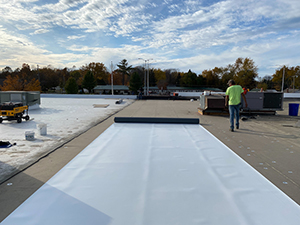
Before choosing TPO, the existing roof should be evaluated for moisture, deteriorated insulation, deck problems, damaged flashing, and drainage concerns. A recover installation may be possible on some buildings, but it should not be assumed just because the existing roof is still in place. Existing materials, trapped moisture, structural conditions, code requirements, and the proposed roof assembly all affect whether recovering or removing the old system is appropriate.
If wet insulation or damaged decking is found, those conditions may need to be removed or repaired before a new membrane is installed. Covering unresolved moisture can hide deterioration rather than solve it.
Attachment Method Should Match the Building
TPO can be installed with different attachment approaches. Mechanically attached and fully adhered assemblies are common, and other approved methods may be used depending on the system design. The correct approach depends on the roof deck, wind exposure, building height, perimeter and corner conditions, insulation configuration, and applicable project requirements.
Attachment should therefore be treated as a design and installation decision, not a generic preference. A building owner should ask what attachment method is being proposed, why it fits the roof assembly, and how the contractor will handle perimeter, corner, penetration, and flashing details.
Drainage Matters on a TPO Roof
TPO is frequently installed on flat and low-slope roofs, so water management is a major part of suitability. Drains, scuppers, gutters, tapered insulation, roof slope, and nearby rooftop equipment all affect how water leaves the roof. A new membrane does not correct an underlying drainage problem by itself.
Before installation, owners should understand whether the roof already has areas of recurring ponding, blocked drainage, or damaged insulation around drains. If drainage improvements are needed, they should be coordinated with the roofing scope rather than assuming the membrane alone will solve the condition.
Reflectivity Does Not Guarantee Energy Savings
Many TPO membranes are available in reflective finishes that can reduce solar heat absorption at the roof surface. That can be useful during warm weather, but the building’s actual energy performance also depends on insulation, roof color, HVAC efficiency, occupancy, operating hours, shade, and the rest of the building envelope.
For that reason, TPO should not be selected on the promise of a fixed cooling-cost reduction. Reflectivity is one factor to compare with the building’s broader performance goals.
Maintenance and Seam Quality Still Matter
TPO is not a maintenance-free roof. Regular inspections can help identify punctures, open or stressed seams, flashing problems, drainage obstructions, surface damage, and issues created by later rooftop work. Service traffic around HVAC equipment and other penetrations can also affect the membrane over time.
A useful maintenance record should include inspection dates, repairs, photographs, drainage findings, and any changes made by other trades. If a problem develops later, that history helps the contractor distinguish a localized repair from a broader condition that needs additional assessment.
Assessing TPO Roofing for a Brice Prairie Property
TPO can be a strong commercial roofing option when the roof assembly and building conditions support it, but climate alone should not make the decision. The existing roof condition, moisture, deck, attachment, wind exposure, drainage, insulation, flashing, traffic patterns, and maintenance plan all deserve review before the system is approved.
Golden Eagle Roofing serves commercial property owners in Wisconsin and currently lists TPO among its commercial roofing services. For a TPO roofing assessment in Brice Prairie, WI, call (608) 633-6719.
Frequently Asked Questions
How is TPO roofing attached to a commercial building?
TPO can use mechanically attached, fully adhered, or other approved assembly methods. The right approach depends on the deck, wind exposure, insulation, roof geometry, and project requirements.
Why is drainage important before installing TPO?
A membrane does not correct an existing drainage problem by itself. Drains, slope, scuppers, insulation, and recurring ponding conditions should be evaluated as part of the roof design.
Can TPO be installed over an existing commercial roof?
Sometimes. The existing roof condition, moisture, deck, code requirements, and proposed assembly must be evaluated before a recover installation is approved.
Does reflective TPO guarantee lower energy costs?
No. Reflective roofing can reduce solar heat absorption at the roof surface, but actual building energy savings depend on insulation, HVAC performance, occupancy, climate, and other building conditions.