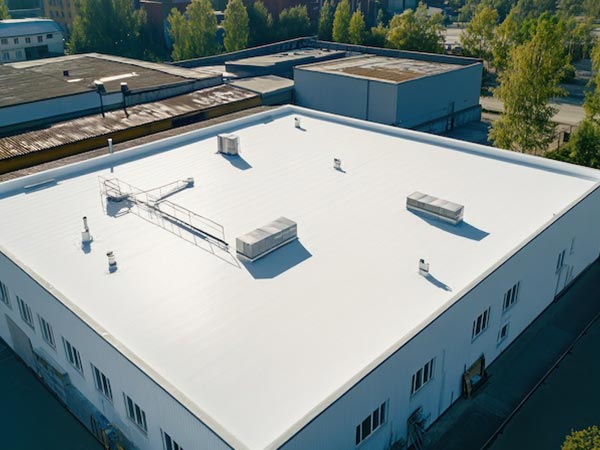
Commercial building owners in Onalaska, WI increasingly encounter TPO when planning a new roof or replacing an aging system. TPO roofing is a widely used single-ply membrane system on commercial buildings, and understanding how it works helps a property manager have an informed conversation with a contractor.
For related commercial roofing guidance in Onalaska, see Standing seam metal roof in Onalaska and Roof maintenance in Onalaska.
Call Golden Eagle Roofing at (608) 633-6719 for TPO roofing in Onalaska, WI.
TPO Roofing 101
TPO stands for thermoplastic polyolefin, a single-ply membrane made primarily from polypropylene and ethylene-propylene rubber, along with additives that give the finished sheet its flexibility, weather resistance, and durability. The finished membrane is produced in large rolls and shipped to the job site for installation, typically in a white or light-colored finish that reflects solar heat rather than absorbing it. The manufacturing process can also include reinforcing layers embedded within the membrane, adding strength and tear resistance without reducing flexibility, part of why TPO has grown popular across many commercial building types.
How TPO Roofing Is Installed

TPO membrane is commonly installed using mechanical fastening, full adhesion, or, in some systems, ballast. The appropriate method depends on the roof assembly, deck, slope, and wind-load requirements. Once the sheets are in place, seams between adjacent panels are heat-welded together rather than glued or taped. A hot air welding tool melts the surface of the TPO at the seam, and the edges are pressed together to fuse into a single, continuous material as they cool. This process is central to how TPO achieves watertightness, since a properly welded seam becomes essentially one piece of material rather than two sheets held together by adhesive that can degrade over time.
Why Seam Quality and Thermal Movement Matter
Seam quality has an outsized effect on how a TPO roof performs over its service life. A weak or improperly welded seam is one of the most common points of failure, since it creates a location where water can work beneath the membrane even though the surrounding material remains intact, which is why the temperature and pressure used during welding matter as much as the material itself.
TPO also needs to accommodate thermal movement as temperatures shift through the year, expanding slightly in heat and contracting in cold. The roof assembly and attachment system must accommodate this movement without placing excessive stress on seams, flashings, or fasteners, since a membrane installed too tightly can develop stress at these points over repeated cycles, eventually leading to seam separation even if the original weld was sound.
What to Understand Before Approving a TPO Roofing Installation
Before approving a TPO installation, a building owner benefits from understanding a few basic points. Membrane thickness, measured in mils, affects durability and puncture resistance, with thicker membranes generally offering better performance. Installation method matters as much as the membrane itself, since even a high-quality membrane can underperform if installed with an approach unsuited to the roof deck or wind exposure. Asking a contractor about their welding process and quality control gives a property manager useful insight into how carefully a project will be executed.
For TPO roofing in Onalaska, WI, contact Golden Eagle Roofing at (608) 633-6719 today.
FAQ
What does TPO stand for, and what makes it different from other flat roofing membranes like EPDM or PVC?
TPO stands for thermoplastic polyolefin, a membrane combining flexibility with resistance to heat and UV exposure. Unlike EPDM, a synthetic rubber typically installed in black, TPO is usually white and reflects more solar heat. Compared to PVC, TPO generally costs less while offering similar heat-welded seam benefits, though PVC has stronger chemical resistance for certain applications.
How are TPO seams welded and why does seam quality matter so much for long-term performance?
TPO seams are joined using a hot air welding tool that melts the surface of adjacent sheets, which are then pressed together to fuse into a single continuous layer as they cool. Seam quality matters because a poorly welded seam is one of the most common points where water can enter, even when the surrounding membrane remains intact.
How long does a TPO roof last, and what affects how close it gets to its rated service life?
A properly installed TPO roof typically lasts 20 to 30 years, though actual performance depends heavily on installation quality, membrane thickness, and ongoing maintenance. Roofs with strong seam welds and regular inspections tend to reach the higher end of that range, while those with installation shortcuts or deferred maintenance often fall short.