
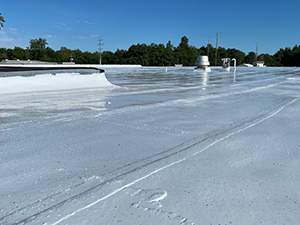
Commercial roof restoration can be a practical option for an aging membrane roof in Eau Claire, WI, but only when the existing assembly is a suitable candidate. The decision should start with roof condition, moisture, adhesion, drainage, and repair needs rather than with a promise that every roof can be restored. Golden Eagle Roofing serves commercial properties in Eau Claire and can be reached at (608) 633-6719.
What Commercial Roof Restoration Includes
A commercial roof restoration typically combines cleaning, targeted repairs, detail work, and a compatible coating or restoration system over an existing roof that is still serviceable. The goal is to improve weather resistance and preserve usable roofing materials without automatically moving to a full tear-off.
Restoration is not the same as covering over unresolved damage. Membranes that are loose, badly deteriorated, or affected by widespread wet insulation may need a larger repair scope or replacement instead. The roof system, previous repairs, drainage, and the condition below the surface all matter when deciding whether restoration is appropriate.
Moisture and Adhesion Must Be Checked First
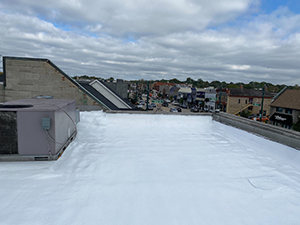
A coating performs best on a clean, dry, compatible surface. If moisture is trapped in insulation or other roof components, coating over it does not remove the moisture and can leave deterioration hidden below the restored surface. Where conditions raise concern, the assessment may include moisture testing or another diagnostic method to identify areas that should be opened, removed, or repaired.
Adhesion also needs to be confirmed for the existing membrane and any previous coating. Depending on the proposed system, test patches, primer, or other preparation may be required. Product selection should follow the assessment instead of assuming that one coating works on every EPDM, TPO, PVC, modified-bitumen, or other membrane roof.
Define the Repair Scope Before Coating
Restoration should have a clear repair plan before the coating stage begins. Loose seams, punctures, failed flashing, damaged penetrations, deteriorated edge details, and localized wet areas may need attention first. If the investigation finds broader deck problems, extensive saturation, or loss of attachment, the contractor should explain whether those conditions move the project beyond a normal restoration scope.
That distinction helps owners compare proposals accurately. One contractor may price a coating-only scope while another includes removal of wet materials, flashing reconstruction, drainage corrections, and reinforced detail work. The lower price is not necessarily the same project.
Preparation and Weather Windows Affect the Result
Surface preparation is a major part of a successful restoration. Dirt, grease, biological growth, loose material, and residues can interfere with adhesion, so the roof must be cleaned and allowed to dry as required for the selected system. Details around seams, curbs, drains, penetrations, and transitions may also need reinforcement or separate treatment before the field coating is applied.
Weather conditions matter during application and cure. Temperature, surface temperature, humidity, dew, wind, and the expected rain-free period can affect whether work should proceed. Rather than relying on one universal temperature rule, the contractor should follow the current written application requirements for the specific coating being installed and adjust the schedule when Eau Claire weather does not provide a suitable window.
Plan Drainage and Maintenance After Restoration
A restored roof still needs drainage and routine care. Drains, scuppers, gutters, penetrations, seams, rooftop equipment, and repaired areas should remain part of the maintenance plan. Water that repeatedly ponds in the same location may signal a drainage or slope condition that deserves attention rather than being treated as something every coating will tolerate.
Golden Eagle Roofing’s commercial roof maintenance guidance provides additional context for ongoing inspections and upkeep. NRCA guidance commonly uses spring and fall as a starting point for scheduled roof inspections, with additional checks after severe weather. The final schedule should also reflect the roof system, warranty terms, building use, and any recurring conditions found during service.
Know What Records You Will Receive at Closeout
Before approving the project, ask what documentation will be provided when the restoration is complete. Useful closeout records may include the approved scope, materials used, repaired areas, application dates, photographs, inspection notes, product data, and any warranty documents that actually apply to the project. The exact package will vary by contract and system, so it should be defined instead of assumed.
Keep those records with the building’s roof file. They can help a future contractor understand what was installed, where repairs were made, and what maintenance or notification requirements apply. If a reflective coating is part of the system, treat energy performance as building-specific rather than assuming a fixed utility-cost reduction.
Planning Commercial Roof Restoration in Eau Claire, WI
Commercial roof restoration works best when the project is built around evidence from the existing roof. Confirm whether the membrane and substrate are serviceable, investigate moisture concerns, define repairs, verify coating compatibility and adhesion, and schedule work for suitable application conditions. For more detail on coating-specific decisions, see Golden Eagle Roofing’s roof coatings guidance for Eau Claire. Call (608) 633-6719 to discuss a commercial roof restoration assessment.
Frequently Asked Questions
How long does a commercial roof restoration last?
There is no universal service-life number. Performance depends on the existing roof, repair scope, coating system, application quality, drainage, weather exposure, and maintenance after the project.
Why does trapped moisture matter before restoration?
Moisture below the surface can continue damaging insulation or other roof components even after a coating is applied. Suspected wet areas should be evaluated and addressed before restoration moves forward.
Can every commercial membrane roof be restored instead of replaced?
No. A roof with widespread saturation, serious substrate deterioration, structural problems, or other conditions outside a practical repair scope may be a better replacement candidate.
What should a facility owner receive after the project?
Ask for the closeout records identified in the contract, such as the final scope, materials, repair locations, photos, inspection notes, and any applicable warranty documents.