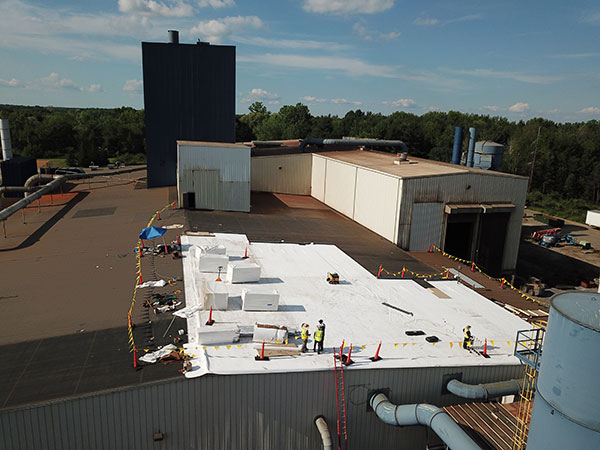
Commercial flat roofs in Wisconsin Rapids must handle sharp seasonal changes, from deep winter cold and snow to warm summer temperatures and strong sun. A membrane system therefore needs to manage repeated expansion and contraction while protecting the building from moisture. TPO roofing has material properties that make it well suited to many commercial buildings in central Wisconsin.
Call Golden Eagle Roofing at (608) 633-6719 for TPO roofing in Wisconsin Rapids, WI.
TPO Roofing Through Winter Temperature Swings
Wisconsin Rapids roofs can experience substantial changes in temperature over the course of a year and sometimes within a shorter period. TPO, or thermoplastic polyolefin, is a flexible single-ply membrane that can accommodate some movement as temperatures change.
Freeze-thaw cycling places added demands on roof surfaces and details. Heat-welded seams join sections of TPO by fusing the membrane together rather than relying on exposed tape or adhesive at the primary joint. Properly prepared welds create a continuous connection that can help limit pathways for water as the roof expands and contracts.
Handling Snow, Ice, and Winter Moisture

Flat commercial roofs in central Wisconsin can collect snow and ice during winter, so drainage and roof design matter alongside the membrane itself. TPO provides a durable weather-resistant surface, but accumulated snow should be considered as part of the building’s overall structural and drainage planning.
Ice can also develop around drains and other low areas, temporarily slowing water movement. A well-maintained TPO roof should be inspected for drainage obstructions, damaged seams, punctures, and flashing problems before winter and after major weather events. Keeping drains clear helps reduce prolonged moisture exposure when snow begins to melt.
Summer Heat and Solar Exposure
TPO membranes are commonly available with white or light-colored surfaces that reflect a portion of incoming solar radiation. During Wisconsin Rapids’ warmer months, that reflective surface can reduce the amount of solar heat absorbed by the roof compared with darker membrane surfaces, which may support lower heat gain through the roof assembly.
Summer inspection remains useful because high temperatures and ultraviolet exposure can gradually affect roofing materials and details. Checking seams, flashing, penetrations, and surface condition after the warm season helps identify damage before colder weather returns. Good installation and regular maintenance also play a major role in how well the membrane performs.
TPO Roofing for Wisconsin Rapids Climate Demands
TPO can be a practical option for owners who need a commercial membrane that can handle seasonal temperature changes while providing dependable weather protection. Its heat-welded seams, flexible membrane construction, and reflective surface give it several characteristics that match the demands of central Wisconsin.
Service life depends on factors such as installation quality, membrane thickness, roof traffic, drainage, maintenance, weather exposure, and the condition of details such as flashing and penetrations. Regular inspections and timely repairs can help owners get more useful years from the system and address small issues before they become larger problems.
Choosing TPO Roofing for Long-Term Roof Performance
No membrane performs independently of the building’s design and maintenance program. For Wisconsin Rapids property owners, evaluating roof slope, drainage, insulation, expected weather exposure, and maintenance needs can help determine whether TPO is the right fit.
For TPO roofing in Wisconsin Rapids, WI, contact Golden Eagle Roofing at (608) 633-6719 today.
FAQ
How does TPO roofing hold up through central Wisconsin’s freeze-thaw cycles and winter snow loads?
TPO is designed to remain flexible across a range of temperatures, while heat-welded seams provide strong membrane connections. Snow performance also depends on structural design, drainage, installation quality, and maintenance.
Does TPO roofing perform differently in summer heat compared to black or dark-colored membrane systems?
A white or light-colored TPO surface generally reflects more solar radiation than a dark membrane, which can reduce solar heat gain at the roof surface. Actual building energy performance depends on insulation, ventilation, roof design, and other factors.
How long does a TPO roof last in a climate like Wisconsin Rapids, and what affects its service life?
Service life varies by membrane thickness, installation quality, weather exposure, roof traffic, drainage, and maintenance. Regular inspections and timely repairs can help protect the membrane and extend its useful service period.