
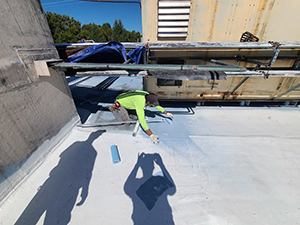
A commercial roof that is declining but not yet failing puts building owners in a difficult position. Replacement can be expensive, but delaying action often leads to more damage and higher costs over time. Roof coatings can be a practical option when applied at the right stage, helping extend roof life, improve performance, and defer replacement without misrepresenting the condition of the system.
Golden Eagle Roofing provides commercial roof coatings for properties in Tomah, WI. Call 608-633-6719 to find out if your roof is a good candidate for a coating system designed for Wisconsin’s climate.
This overview explains what makes a roof suitable for coating, what conditions may disqualify it, how coating systems perform in cold-weather environments, and what property owners should understand before moving forward with the process.
Roof Coatings Bridge the Time Gap Before Replacement
The gap between a roof that still has structural integrity and a roof that is ready for replacement is exactly where a quality coating system earns its value. A Tomah commercial building with a membrane that is showing surface wear, minor cracking, or lap adhesion loss but still has a sound deck and dry insulation is a strong coating candidate. The coating goes on over the existing membrane, sealing surface defects, reinforcing lap areas, and creating a fully adhered waterproof layer that protects what is underneath from continued UV and moisture exposure.
Done correctly, that system realistically adds years of service life, buying the building owner time to plan and budget for eventual replacement without operating a roof that is actively failing. The critical qualifier is that word correctly. A coating applied to a roof with wet insulation, widespread membrane failure, or a deteriorated deck is not buying time. It is covering up a problem that will resurface.
Roof Coating Assessment
Not every roof that looks like a coating candidate actually is one, and an honest pre-coating assessment is what determines whether the investment makes sense. The key qualification factors are dry insulation confirmed through core cuts or infrared scanning, a membrane that still adheres well across the majority of the roof field, and a deck with no significant structural deterioration. When those conditions are met, coating is a viable path.
When insulation moisture is present in multiple zones, when membrane adhesion has failed across large areas, or when deck rot is present underneath, these conditions produce a temporary result at best. A contractor who recommends coating without thoroughly assessing the existing assembly is selling a product into a situation where it will not perform.
Conklin Roof Coatings Performance
Wisconsin’s climate is one of the more demanding environments a roof coating can face. Summer UV exposure works on the coating surface through the warm months, then freeze-thaw cycling runs from late fall through early spring, putting mechanical stress on any coating that has lost its flexibility. Conklin elastomeric systems are formulated to maintain flexibility well below freezing, allowing them to move with the roof substrate through Wisconsin’s full temperature range without cracking or delaminating. Cheaper coatings use lower-grade polymer chemistry that becomes brittle in cold weather, and that brittleness shows up as surface cracking within a few seasons. The chemistry difference is the reason a properly applied Conklin system on a qualifying Tomah roof continues to seal and protect through winters that compromise a lesser product.
Roof Coatings Application Process
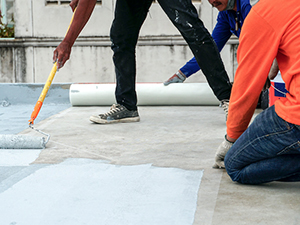
Surface preparation is what separates a coating that holds from one that peels. The existing membrane must be pressure washed clean before coating begins. All seams, cracks, and penetration flashings are reinforced with fabric and base coating before the full system goes down. The coating is applied in multiple passes to achieve the specified dry film thickness, and wet film thickness is checked during application to confirm the system is built to spec. Ambient temperature during application must fall within the product’s specified range, making late spring through early fall the practical installation window in Wisconsin. A contractor who coats in marginal conditions to meet a schedule compromises the cure quality of every coat they apply.
Are Roof Coatings Right for Your Building?
Roof coatings provide commercial building owners with a practical way to extend roof life when the system is properly evaluated and prepared before application. A thorough assessment is essential to determine whether the existing roof is a suitable candidate, ensuring the coating performs as intended and delivers long-term value.
Golden Eagle Roofing provides commercial roof coating services for properties in Tomah, WI. Call 608-633-6719 to schedule an assessment and learn what condition your roof is in before moving forward with a coating system.
FAQ
How many years of additional life can a roof coating add to a Tomah commercial roof?
A properly applied Conklin coating system on a qualifying roof can realistically add 10 or more years of service life, depending on the condition of the existing assembly at the time of application.
Can a Conklin roof coating be applied over a metal roof as well as a membrane roof?
Yes, Conklin’s MR System is specifically designed for metal roof restoration and is one of the most effective coating solutions for aging metal commercial roofs in Wisconsin.
Is a roof coating renewable once it reaches the end of its warranty period?
Yes, Conklin systems can be cleaned and recoated at the end of the coverage period to renew the warranty and extend protection without removing the existing coating.
Does roof coating change the appearance of a commercial building in Tomah?
Most commercial elastomeric coatings are white or light gray, giving the roof a clean, uniform finish that many building owners consider a visual improvement over a weathered membrane surface.